- Home
- Departments
- Community Services
- Trees (Urban Forestry)
- Landmark Trees
Landmark Trees
800 West St.
Woodland Cemetery
Canary Island Palms
Tree added to Landmark Trees in 2025
There are a total of 42 Canary Island date palms, Phoenix canariensis, located in the historic Woodland Cemetery as follows:
- 15 palms planted linearly running east-west facing Cross Street
- 24 palms lining the north-south paved road in the interior of the Cemetery
- 1 palm located near the east side of this roadway
- 2 palms are located west of this roadway
These regal palms lend structure and elegance to their landscapes and have been widely planted throughout California’s temperate climate zones for much of its history. As the name implies, this palm species is native to the Canary Islands, located off the northwest coast of Africa, where it is honored as the natural symbol of these islands.
The first set of 15 palms at the Woodland Cemetery was planted in 1904, set back from Cross Street at an Arbor Day planting.
512 Gibson Road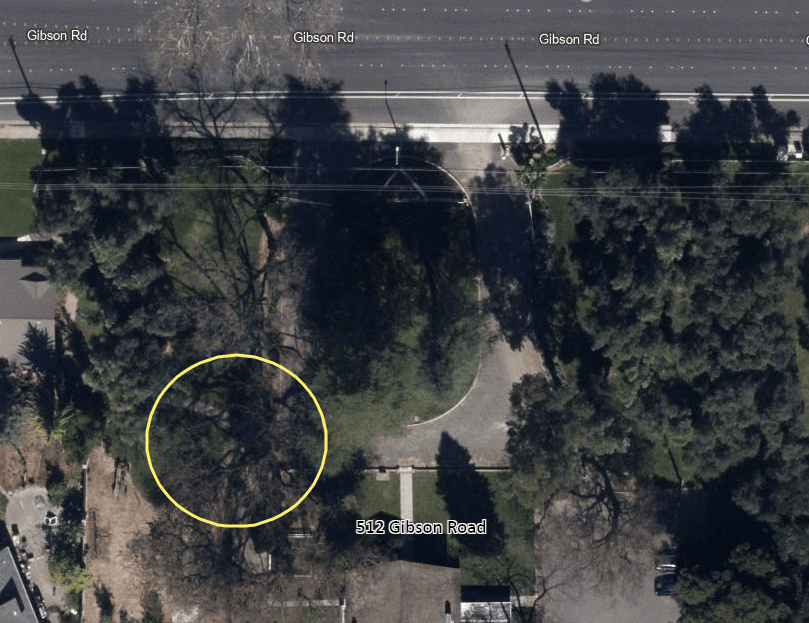
Gibson House Yolo County Historical Museum
Valley Oak
Tree added to Landmark Trees in 2020
Please see the attached historical essay “Woodland’s King Oaks” by David Wilkinson, taken from his book manuscript "Gertrude’s Oaks.” This essay (Woodland's King Oaks) provides historical context and the basis for nominating this oak. This ancient oak is Woodland’s largest and oldest tree and is located in a very visible place, accessible to the public.
524 Third Street 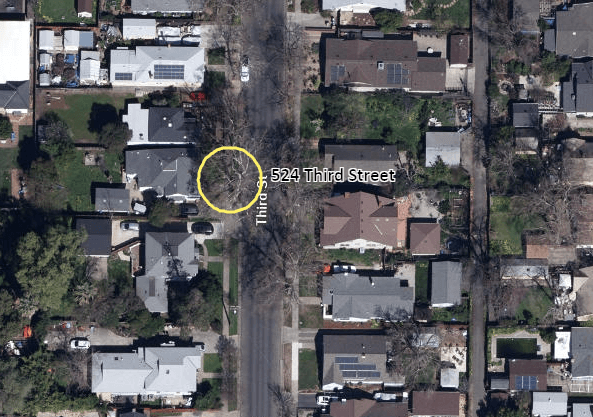
London Plane
Tree added to Landmark Trees in 2020
Historical Context: Plane trees were the rage beginning in the 1920s and were heavily planted throughout Woodland throughout the twentieth century. Commonly called “oriental” planes back in the day, they are actually the “London” plane (Plantanus x acerifolia), a hybrid whose parents are the Oriental plane native to Eurasia (Platanus orientalis) and the American plane (Platanus occidentalis), native to the eastern United States. A California native species of plane tree is also found in Woodland—and grows wild near the Sacramento River-- the Western Sycamore (Plantanus racemosa).
London plane trees rapidly grew in popularity and became one of the most widely planted city trees for two key reasons. A healthy specimen is fast-growing and provides spectacular shade, rivaling the American elm. Second, they were affordable and available: in a 1919 ad appearing in the “Democrat,” seven-foot “oriental” plane trees were selling for $1.00 each or ten trees for $8.50, well within the price range of most Woodland residents.
Prominent Woodland people are associated with the London plane tree. J. Grant Bruton was a WWI veteran who served on the Mexican border. In peacetime, Bruton became a Woodland attorney and was elected as a Yolo County Superior Court judge in 1934. In 1928, Bruton and his wife Irma, a librarian, built a charming and romantic French cottage with triple French doors on a wide lot at 415 Bartlett Avenue, a street named for Washington M. Bartlett was a California governor who died in office in 1887. The Brutons wanted shade and plenty of it, not just for themselves but for the entire neighborhood. To achieve this leafy lofty vision, they donated enough London plane trees to line both sides of Bartlett Avenue between College and Elm Streets. High School students planted the trees under the guidance of agricultural instructor Luther Du Bois. City Engineer Asa Proctor had his staff stake the trees.
The plane tree craze spread up and down Elm Street (as American elms were phased out due to disease concerns) and throughout the mid-twentieth century middle-class neighborhoods east of the Bruton’s house. London planes were widely planted in Beamer Park, which was built after the Great Depression. London planes are susceptible to the anthracnose fungi that live on plane trees, permanently disfiguring the weaker trees, which cannot regenerate damaged branches and limbs. We see many disfigured planes in Woodland. However, the huge specimen being nominated for landmark status at 524 Third Street is vigorous and monumental and stands apart from its many cousins spread throughout Woodland neighborhoods, schools, and parks.
This is a City public tree located in the planting strip. The tree is Woodland’s most prominent London plane and one of the largest and tallest trees of any species in Woodland. It has a diameter of 58.0 inches and is 107 feet tall. This specimen is unique for its exceptional girth and height. It has been a haven for birds and an arboreal beacon in this historic neighborhood for perhaps a century.
625 Elm Street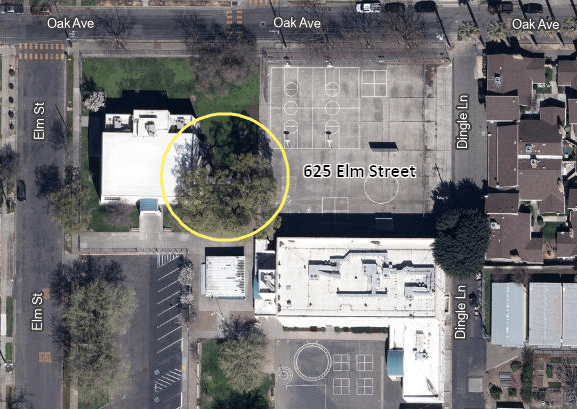
Dingle Elementary School
Valley Oak
Tree added to Landmark Trees in 2020
Historical Context (from “Explore Historic Woodland” Guidebook (p.43): “This location has been a school site since a two-story wooden school house was built here in 1889 facing Oak Street, nestled under the ancient valley oaks that still grace the campus. In 1914, the community approved a school bond measure that funded a modern two-story brick school in the Renaissance Revival style designed by William H. Weeks, which faced Elm Street, where the parking lot is today. It replaced the Oak Street School. Opening in 1915, it was initially named the Elm Street School, then later changed to the Woodland Grammar School. In 1948, the Annex was constructed and became the main part of the school in 1967, when the brick building no longer met earthquake safety standards. It was eventually demolished in 1975. The multi-purpose building was completed in 2004 with funding provided by a local school bond. Charles. E. Dingle was the long-time principal of the school. In 1926, the school was re-named in Dingle’s honor shortly before he passed away. In recognition of the school’s long-time role in educating Woodland children, the site was designated a Woodland Historical Landmark.”
The tree being nominated is the only large oak remaining on the core Dingle campus. This majestic valley oak is the native tree species that inspired the City of Woodland’s name. The valley oak is the largest of the California oaks and can live for centuries. Today, due to past use for fuel wood, clearing to make room for crops, and urban development, most of the once-abundant valley oaks have disappeared from Woodland and the surrounding lowland areas of Yolo County.
This remaining valley oak may have been planted by a California scrub jay perhaps 230 years ago, long before Woodland was established. One of the largest oaks remaining in Woodland, in 2020 it measured 57.2 inches in diameter four and a half feet above the ground and is 77 feet tall.
525 Beamer Street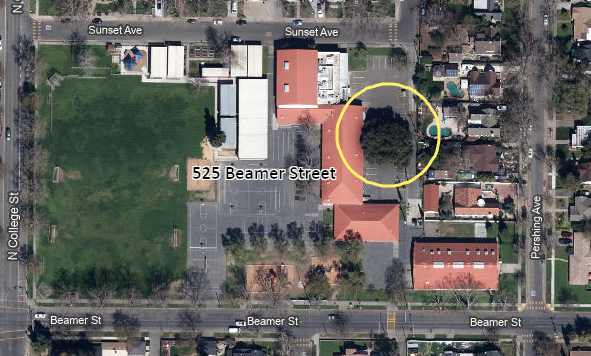
Beamer Elementary School
Cork Oak
Tree added to Landmark Trees in 2020
Historical Context (from “Explore Historic Woodland” Guidebook (p. 285): “On September 2, 1930, Beamer Park School welcomed its first class of students, beginning its many decades of service to Woodland’s elementary school children. The Woodland School District hired the San Francisco architectural firm of William H. Weeks to design a school campus in keeping with the “most up-to-date and approved-of designs.” [The 1930 campus] consisted of eight classrooms for grades 3-6, administrative offices, and the nurse’s office. In 1940, the 7th and 8th grade wing of classrooms was added, perpendicular to the main building and connected to it by a ramp. A school bond in 1950 provided for a primary school annex, and the following year, the auditorium/gymnasium was constructed, along with a cafeteria. In the mid-1970s, the original building aged considerably, and due to earthquake safety concerns, it was demolished. A playground now occupies the space. The current administrative offices and a school library, situated parallel to Beamer Street but set back from the road, were constructed in 1975
Cork oaks are native to Southern Europe and northern Africa, near the Mediterranean Sea. They are named for their bark, which contains the cork used in glass bottle stoppers and many other useful products. Portugal, the largest source of the world’s cork, allows the cork to be harvested many times over the tree's life without damaging the tree.
Cork oaks were brought to California as acorns in 1865. During the Second World War, a renewed effort was made to start a successful cork industry here. In California, their acorns provide a food source for birds and wildlife. Cork oaks can reach a large size with long spreading branches, providing a nice centerpiece with year-long shade from their evergreen leaves. In Woodland, cork oaks can easily grow to 70 feet tall and as wide at maturity. They can live for over 200 years. The cork oak on the Beamer Elementary School campus is a classic spreading specimen that provides a degree of protection and comfort for students. It has a measured diameter of 47.5 inches and a height of 45 feet, evidencing its long history at this historic school
420 Third Street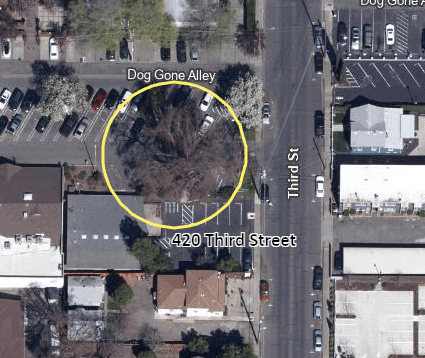
American Elm
Tree added to Landmark Trees in 2019
The iconic American elm (Ulmus americana) located at 420 Third Street is one of the few remaining historical American elms whose upper limbs were not “topped” by the City years ago. This tree is likely a century old and has a 62.1” diameter. It has retained its renowned and iconic spreading canopy. A beloved American tree noted for its toughness and dappling shade, it was widely planted throughout U.S. cities until Dutch elm disease (DED) destroyed millions of elms beginning in the 1930s.
The few remaining American elms checkering Woodland streets are survivors. These trees were widely planted in Woodland in the nineteenth and early twentieth centuries and valued for their tremendous shade properties and hardiness. By the 1930s, however, Woodland’s elms became infested with the elm leaf beetle, whose larvae feast on the leaves, denuding the tree of its canopy. According to City records, in 1936, when Woodland began spraying to control the elm leaf beetle, there were about 650 elms in Woodland.
Eighty years later, there are only 75 American elm street trees cared for by the City, with a handful of others dotting private residences in the core area. Most of these trees are in decline due to their age and structural issues related to the tree topping, which weakened upper branches. One reason American elms fell out of favor as a street tree was the fear of DED infecting the elms. Consequently, few (if any) American elms were planted in Woodland after the 1930s. Fortunately, DED has never infected any of Woodland’s American elms. However, many were removed in the late twentieth century when Woodland embarked on road-widening projects in the older section of town. Entire City blocks were left devoid of shade.
In recent years, the Woodland Tree Foundation and City have planted hybrid Asian elms to reintroduce this valuable tree species to Woodland. Today, disease-resistant American elms are once again being planted in the country. Landmarking the American elm at 420 Third Street will honor the most iconic historical shade tree planted in Woodland and explain the reasons for its disappearance. Honoring this regal tree will also serve as a bridge between the eras when this elm was widely planted and valued for its canopy and efforts being made today to reintroduce disease-resistant Ulmas americana to the American landscape.
526 Marshall Avenue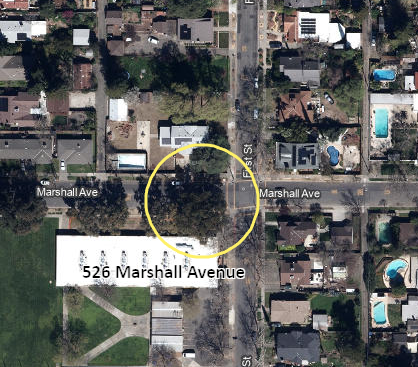
Douglass Middle School
Cork Oak
Tree added to Landmark Trees in 2019
The cork oak (Quercus suber) located in the planting strip on the southwest corner of First Street and Marshall Ave appears to be very old with a 61.1” diameter. It may have been planted at the time when Hesperian College moved from downtown in the 1890s to this location (see City historic marker placed along College Street, near Marshall Ave.). This site eventually became Woodland’s first public high school. There are many cork oaks in Woodland, as they are well adapted to the local climate.
520 West Street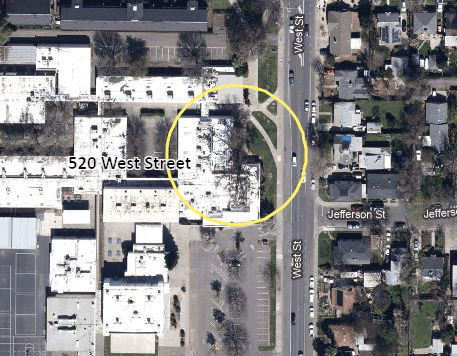
Lee Middle School
Valley Oak
Tree added to Landmark Trees in 2019
The valley oak (Quercus lobata) located at Lee Middle School adjacent to the school building, about 200 feet south of the intersection of West and Lincoln Street, is a very large specimen tree with a diameter (at breast height – DBH) measuring 72.9 inches in October 2018. This is the fourth-largest diameter tree in Woodland. This tree is in good health, has been tastefully pruned by the Woodland Joint Unified School District, and remains an aesthetically pleasing tree. Its location on public school property makes it a good candidate for imparting an appreciation of native trees to Lee Middle School students.
525 Granada Street
Douglass Middle School
Valley Oak
Added to Landmark Trees in 2019
The valley oak located at Douglass Middle School, just south of the multi-purpose room, has a diameter at breast height of 51.3". Though it is quite smaller than the tree at Lee Middle School, it is an aesthetically pleasing tree that, with continued good care by Woodland Joint Unified School District, will continue to grow and thrive and yield benefits for many more decades (perhaps even many generations), including cooling from shade and resulting energy savings, air pollution mitigation, food and habitat for native scrub jays, stormwater attenuation, and beauty.
It will also serve as an example of our native Sacramento Valley natural history, which, by its mere presence, will be noticed and appreciated by current and future Douglass Middle School students. Some of these students might perhaps be inspired by this tree and develop an interest in working to preserve native trees, or trees in general, or work in other areas of natural resource management.
.
810 Hollister Road
Beamer Park
2 Valley Oaks
Added to Landmark Trees in 2017
The two large native Valley Oak trees at Beamer Park were saved only because the park was built around them. Once upon a time, the Beamer Park subdivision had an abundance of native oaks. The trees were used as a marketing tool for the rustic housing enclave. Since then, most have disappeared, greatly altering the skyline and appearance of this historic housing tract.
629 Cleveland Street
City Park
Valley Oaks and Paradox Walnut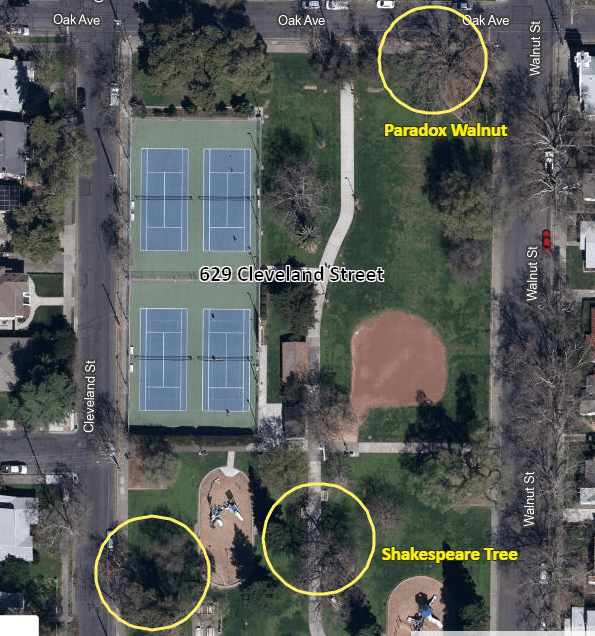
Added to Landmark Trees in 2017
There are two large native valley oak trees in City Park. One is near the center of the park and is known as the "Shakespeare Tree." The second valley oak is located along the Cleveland Street side of the park.
City Park is Woodland’s oldest park. The Women’s Improvement Club raised money to buy the land, which was donated to the City for the public park with explicit instructions to preserve the native oaks growing within its boundaries. Only one original native oak remains in the park.
Shakespeare Oak Tree planted in 1916
Six years after City Park opened to the public in 1910, The Woodland Shakespeare Club planted this valley oak to mark the tercentennial (300th) anniversary of William Shakespeare’s death and honor the world’s greatest playwright and poet. Founded in 1886, Woodland Shakespeare Club is the oldest women’s literary club in California. This engraved stone bench and tree were their gifts to the people of Woodland.
“As this tree develops, may it teach us the lesson of its kind—the sturdy qualities, the glory of facing the storms and, having faced them, stand ready to face as many more…and may all those who will enjoy the comfort of this seat and, in the coming years, the sheltering shade of this oak…honor Shakespeare’s memory and be reminded that even a little candle may throw its beams afar.” ~Woodland Shakespeare Club
250 First Street
Woodland Public Library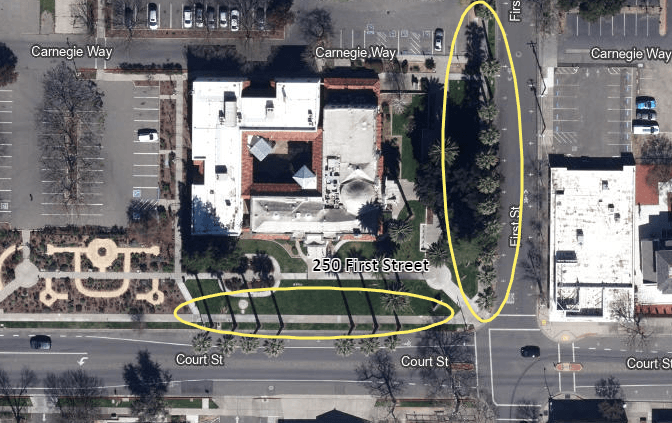
Palm Trees
Added to Landmark Trees in 2005
Mayor Richard H. Beamer (1849-1916) personally purchased and supervised the planting of the Canary Island date palms rising majestically in front of the Woodland Public Library. California fan palms were added in the planting strips bordering the library on First and Court streets shortly after the library was constructed in 1905.
"Mayor Beamer has presented the library trustees with 26 California palm trees. The trees arrived from Los Angeles several days ago and were conveyed to the new Carnegie Library site Monday, where they will be used to beautify the grounds. The mayor deserves the thanks of the entire community for his splendid gift."
Beamer’s palm landscape was known as “Library Park.” The Canary Island palms have grown tall and gracefully sway in the seasonal breezes, are evergreen, and complement the Mission Revival style architecture of the library, inspired by the romance of Spanish California. Calling the palms “his monuments,” Mayor Beamer personally cared for the palms until they were established. Richard H. Beamer left a legacy of trees. A highly accomplished public figure and businessman, Beamer loved planting trees as his “hobby.” Beamer’s beloved palms at the library live on. In 2005 the Woodland City Council designated the Canary Island and California fan palms at the library “landmark trees” based on their historical significance.